
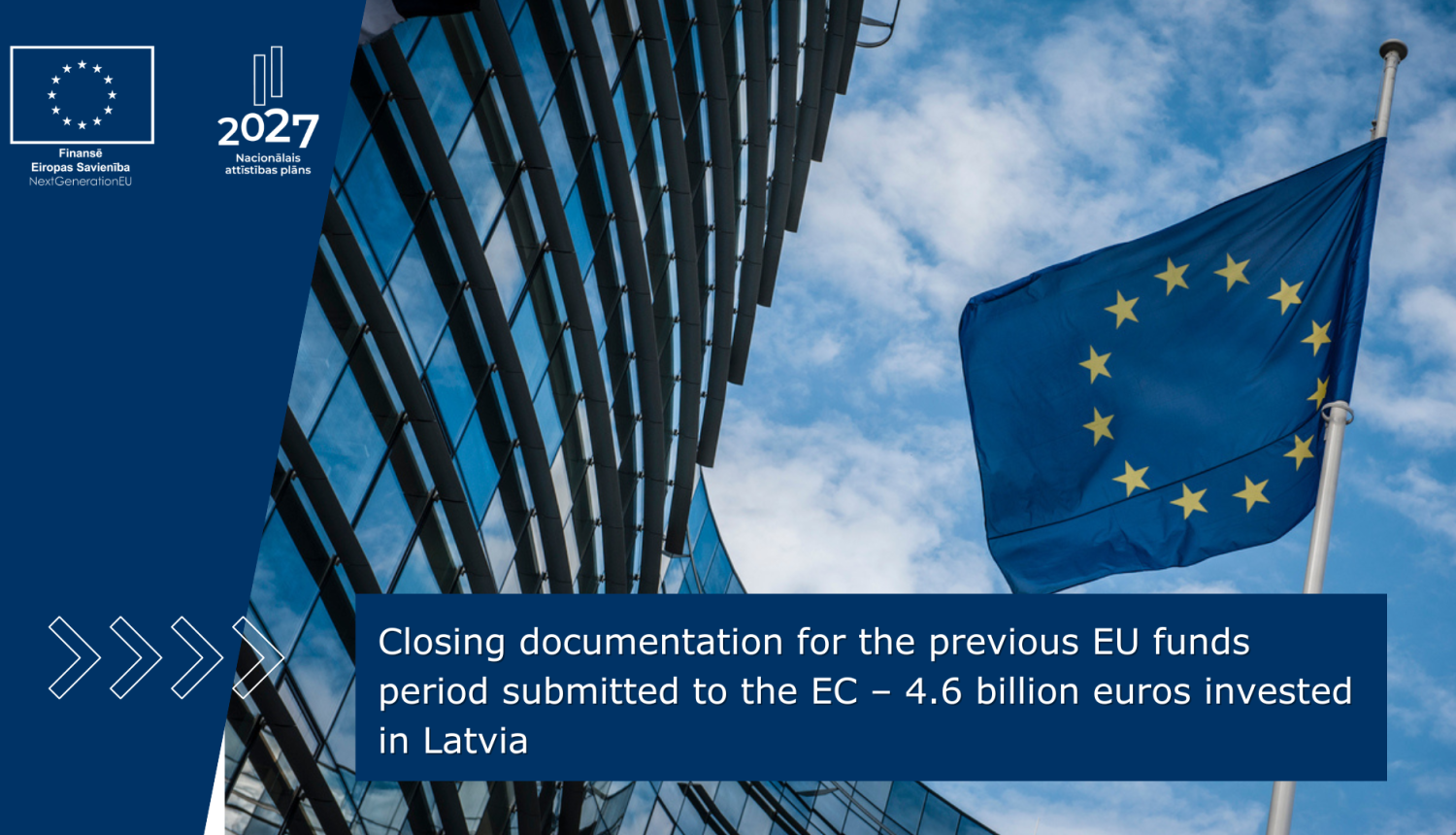
With the final documentation prepared by the Ministry of Finance (MF) and the State Treasury, as well as the submission of the Audit Authority's opinion and final control report to the European Commission (EC), the 2014-2020 European Union (EU) fund programming period has come to an end. The EU funding available under this period – EUR 4.6 billion – has been fully invested in the country's development through the implementation of around 2,450 projects in various fields.
Although the planning period formally ended in 2023, in accordance with EU regulations, project implementers took advantage of the opportunity to continue and complete project implementation at their own expense, or individual projects were divided into stages and completed with funding from the next EU fund period. Payments to project implementers for eligible expenditure and project audits also continued. Extensive final documentation had to be submitted to the EC by mid-February 2026, after which the planning period will be officially closed following EC approval.
“The period from 2014 to 2020 was a difficult time – its final phase coincided with global upheavals that affected project costs and implementation deadlines. This required active risk management and timely decisions to ensure that the allocated funding was fully invested. As a result, thanks to the targeted and effective work of project implementers, more than two thousand projects with significant benefits for society were implemented during the nearly ten-year investment cycle, strengthening the competitiveness of companies, modernizing infrastructure, and promoting employment. The impact of EU funds on Latvia's economic growth and development is also confirmed by macroeconomic calculations – Latvia's GDP in 2024* would be 8.7% lower without EU fund investments," summarizes Armands Eberhards, Deputy State Secretary for EU Funds.
As a result of the investments, the competitiveness and productivity of nearly 6,900 companies have been strengthened, energy efficiency has been improved in almost 23,000 households, and more than half a million residents have participated in EU fund-supported measures. More than 300,000 people have enhanced their skills in the labor market, around 100,000 persons at social risk have received support for job creation and retention, while approximately 90,000 residents have received support through health promotion and disease prevention measures. Simultaneously, about 20,000 medical professionals improved their qualifications or were attracted to work in the regions.
The audit authority regularly assessed the EU fund administration system and project implementation in Latvia on behalf of the EC. “The audit results confirm that at least 98% of projects that have received EU funding and been recognized as eligible have been implemented without significant irregularities and have made a real contribution to society. This confirms the motivation of project implementers and their responsible approach to the use of investments. Discussions on what can be improved in the future are important, but at the same time it is essential to assess what has already been achieved and the opportunities that EU fund investments have provided for Latvia," emphasizes Nata Lasmane, Head of the EU Funds Audit Authority.
Macroeconomic assessments show that EU fund investments have a significant impact on the economy. EU funds have increased all components of GDP expenditure – private and public consumption, investment, exports, and imports. With the support of EU funds, Latvia's exports in 2007–2025 were on average 4.8% higher than in the scenario without investments, imports were 3.8% higher, improving the external trade balance by an average of 0.6 percentage points of GDP (in recent years – slightly more than one percentage point).
Most of the impact of EU funds on GDP is linked to increased labor productivity, which accounts for 87% of the total impact. On average, labor productivity (average for 2007–2025) with EU fund investments was 5% higher than without them, but in 2024 it was 7.4% higher. At the same time, EU funds have also promoted employment – the number of people in employment was 0.75% higher on average in 2007–2025, while the unemployment rate was 0.2 percentage points lower.
It has already been reported that the full implementation of the allocated funding was ensured by risk management measures introduced by the government in a timely manner and preventive decisions taken, such as budget overcommitment options, compensating for project delays for purposes such as energy efficiency in centralized heat supply, health and education infrastructure, etc. The EC's offer to refinance state budget-covered heating support for vulnerable households was also used. Similarly, the government supported the EC's offer to complete certain projects in the longer term, financing the final phase from its own resources or using funding from the next EU funding period, such as the construction project for the A2 building of Stradiņš Hospital and railway projects (platforms, infrastructure modernization to increase speed, etc.).
The period from 2014 to 2020 marks the end of a significant investment cycle in the development of Latvia's economy. At the same time, the implementation of the Recovery and Resilience Facility investments and the EU fund program for 2021–2027 will continue, with EU fund projects to be implemented by 2030.
"This year's priority will be to successfully complete the Recovery and Resilience Plan and investment plan, ensuring that Latvia receives the full €1.97 billion in funding allocated to it. At the same time, the goal is to maintain a high pace of EU fund investment implementation, and we have already begun preparations for the next planning period from 2028 to 2034 to ensure a continuous and predictable flow of investment," notes A. Eberhards.
More information on the closure of the 2014-2020 EU funding period is available on the EU funds website.
*Cumulative impact since 2007, excluding the European Agricultural Fund for Rural Development (EAFRD).