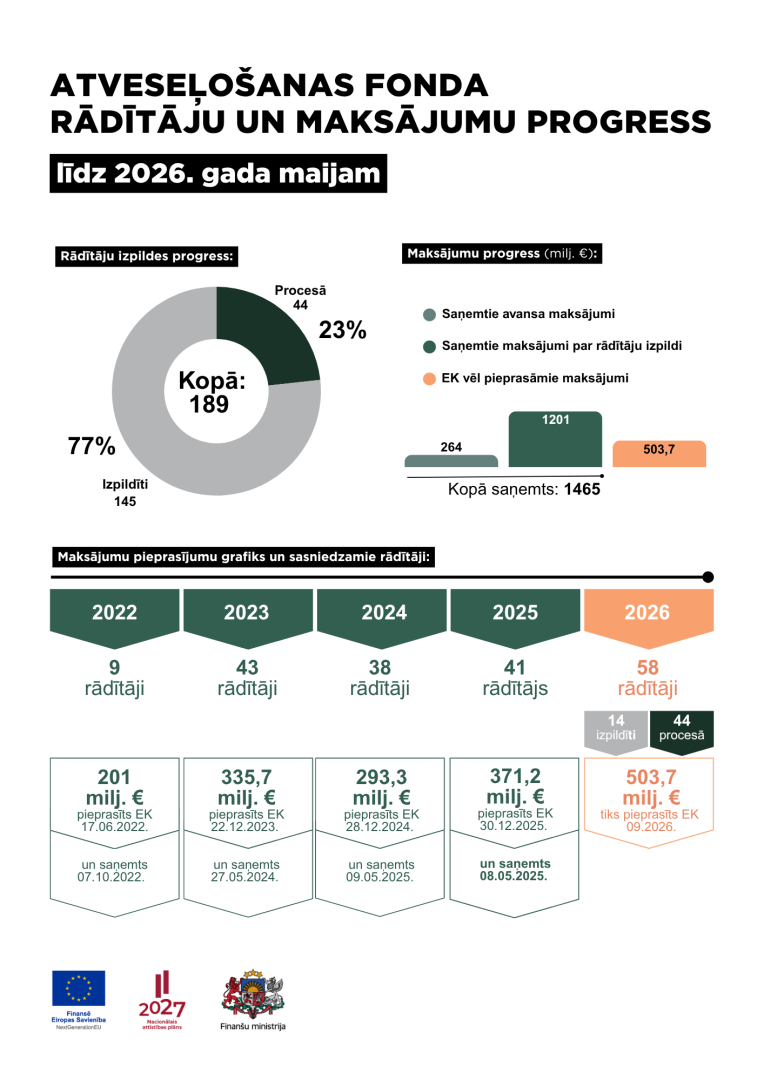

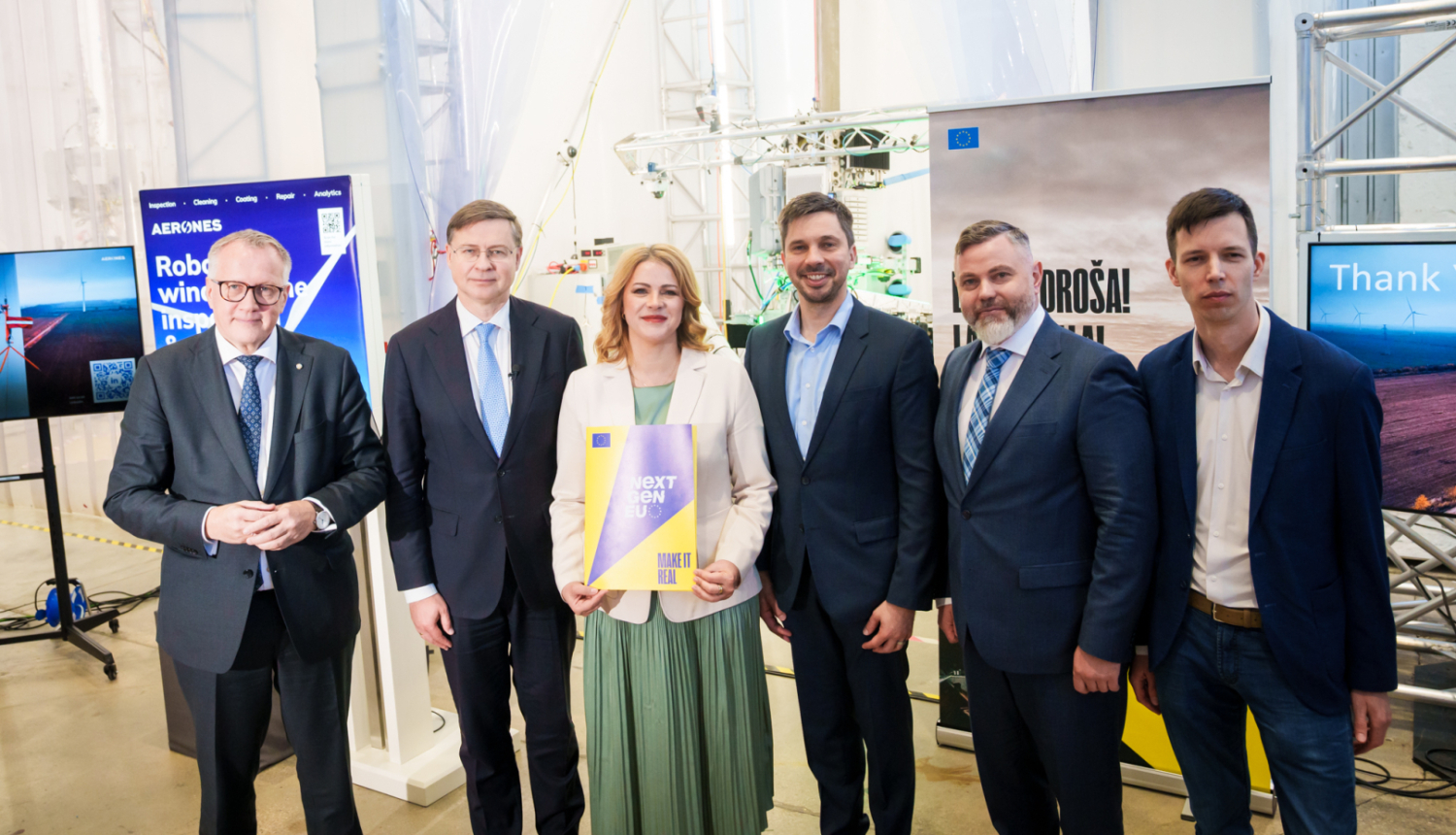
On Friday, May 8, the fourth and penultimate payment from the Recovery and Resilience Facility (RRF) - amounting to 371.2 million euros - was received into the state budget at the Latvian high-tech company “Aerones.” This payment is part of the total €1.97 billion available to Latvia. The payment was made after the European Commission (EC) assessed and approved the successful implementation of the 41 reform and investment indicators set out in Latvia’s RRF plan, for which Latvia’s payment request and supporting documents were submitted to the EC at the end of 2025. With this fourth payment, Latvia has now received a total of nearly 1.5 billion euros in the budget, or 75% of the total AF allocation.
The venue for the event was chosen specifically to highlight, as one example, the RRF investments in productive innovation within the company and its contribution to Latvia’s economic growth. “Aerones” is a Latvian high-tech company that develops robotic solutions for wind turbine maintenance and provides services worldwide. At the end of 2025, the company received the “Breakthrough” award, having attracted more than 53.2 million euros in investments, the largest amount among Latvian startups during that period. In addition to private investments, it has secured European Union (EU) funding, including several complementary projects under the RRF, developing solutions for wind turbine diagnostics, maintenance, and repair, and servicing wind farms worldwide.
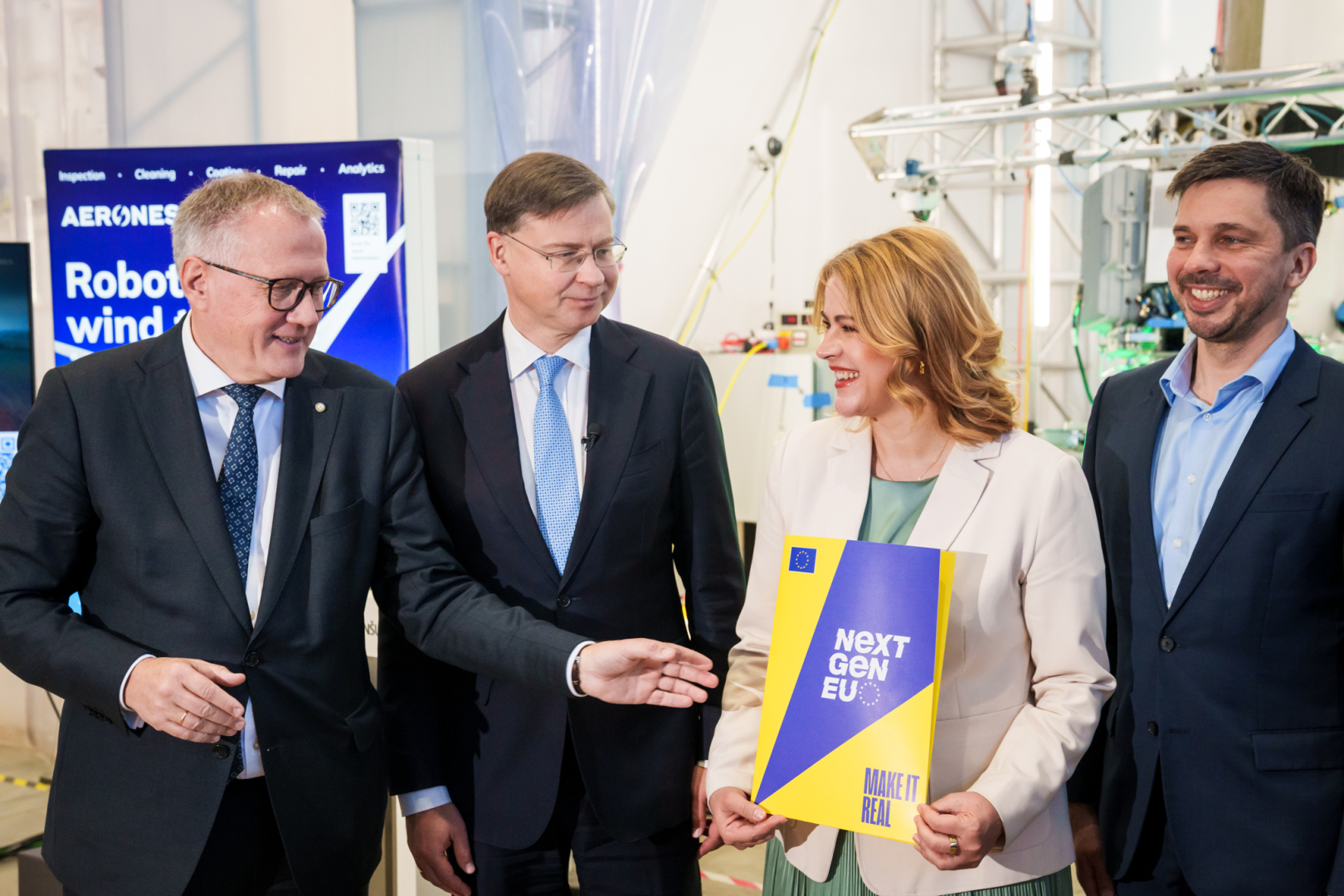
At the event, Valdis Dombrovskis, European Commissioner for Economy and Productivity, Implementation, and Simplification, presented Prime Minister Evika Siliņa and Finance Minister Arvils Ašeradens with a payment certificate in the amount of 371.2 million euros.
“371.2 million euros is not just a number in a budget line. It means practical improvements in people’s daily lives: more affordable housing, insulated buildings and lower heating bills, better working conditions for rescue and disaster management services, higher-quality healthcare, more modern infrastructure, and a higher standard of living in the regions. In the European Commission’s view, Latvia has successfully implemented a comprehensive package of reforms and investments, promoting the country’s development. With this payment, Latvia will have received nearly 1.5 billion euros, or 75% of the total available funding. “It is now essential to maintain the momentum and successfully complete the remaining reforms and investments by the conclusion of the Recovery and Resilience Facility plan on August 31, achieving the greatest possible return for Latvian society,” emphasized V. Dombrovskis.
E. Siliņa stated: “The fourth payment from the Recovery and Resilience Facility is proof that Latvia is fulfilling its commitments. From investments in hospitals to industrial parks in the regions—these investments are a powerful driving force for our economy, security, and social resilience. But time is running out. By the end of August 2026, we must complete what we have started, demonstrating that every euro invested works for the benefit of the people of Latvia.”
Upon receiving confirmation of the payment, the Minister of Finance stated: “The implementation of the Recovery Fund in Latvia has entered a decisive phase, with final investment works and payments for projects still being carried out intensively. For the second year in a row, the largest-ever amount of EU funds and Recovery Fund financing - more than 1.4 billion euros - is being allocated to economic growth. These are very concrete investments in roads, healthcare, housing, energy efficiency, digitalization, and business competitiveness. At the same time, the final and most demanding phase lies ahead, with clear deadlines and a high level of responsibility. Therefore, our priority at this time is to complete reforms and investments on time, manage risks in a targeted manner, and, in close cooperation with the European Commission, ensure that Latvia makes full use of the funding available to it.”
“We started out as a group of crazy enthusiasts coming up with seemingly impossible ideas at a time when the world knew very little about wind turbines. Our supporters, creative team, and boldness helped us become a real company. In turn, support from EU funds and the Receives Fourth Recovery Facility served as a crucial catalyst for our further development. Latvia needs this kind of support for startups-which can be small but effective in the early stages - to convince major investors to invest in the development of these ideas,” emphasized Dainis Krūze, co-founder and CEO of Aerones, at the event.
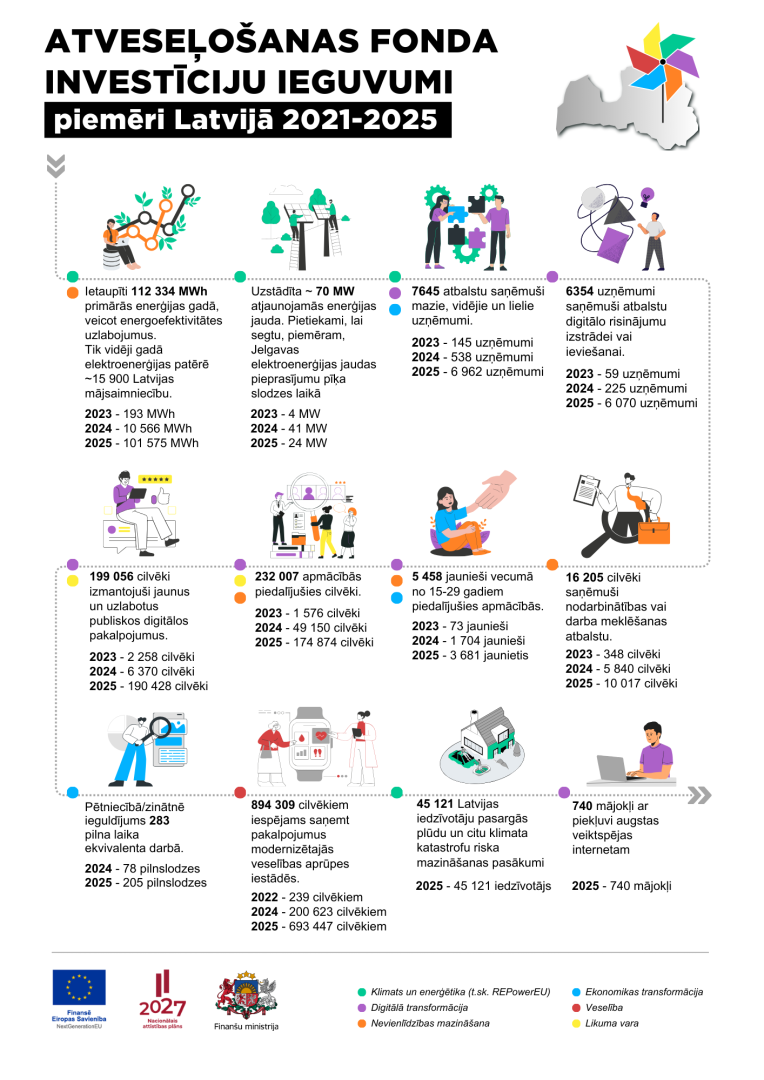
In the fourth phase, by meeting 41 indicators, results of significance to society were achieved in all areas of the Action Framework.
- For example, in the area of reducing inequality, 366 km of national, regional, and local roads were renovated, improving access to county centers and road safety. A financing fund was established for the construction of low-rent housing, with plans to build 476 new apartments. Municipalities are implementing projects to adapt housing for 250 people with disabilities. To strengthen labor market skills, more than 21,000 unemployed individuals, job seekers, and people at risk of unemployment have participated in training programs.
- In the health sector, a unified approach to oncology care has been introduced as part of the establishment of the Latvian Cancer Center. Significant investments have been made to strengthen the infrastructure of 20 outpatient healthcare providers, improving epidemiological safety, accessibility, and integrated care, thereby enhancing the quality and availability of services throughout Latvia.
- In the climate sector, projects to improve the energy efficiency of apartment buildings worth nearly 60 million euros are being implemented, as well as energy efficiency projects for municipal buildings and infrastructure totaling 27.6 million euros. In the energy sector, amendments to electricity market regulations have been adopted, creating the conditions for more flexible power grid management and broader use of renewable energy. Amendments have also been adopted to the rules governing the registration and operation of energy communities, which, among other things, require municipalities to allocate a portion of the economic benefits generated by energy communities
- In the area of digital transformation, more than 600 training courses have been provided to businesses to help them acquire basic digital skills. To promote the digital transformation of businesses, loan agreements have been signed, attracting 45.3 million euros in private funding. A support scheme for digital skills has been established to strengthen the digital transformation of the media sector — 26 agreements have been signed to promote the digital competencies and media literacy of media sector professionals, as well as to strengthen local media’s ability to adapt to the digital environment and their resilience against disinformation.
- To promote economic growth and productivity, regulations for four support programs have entered into force—for centers of excellence, research, cooperation networks, and Latvia’s participation in projects of common interest to Europe. The support programs aim to increase private investment in research and development, promote local and international cooperation, and foster the development of new products and technologies.
- To strengthen the rule of law, an Anti-Money Laundering Innovation Center has been established to enhance cooperation in financial intelligence and knowledge sharing. A building permit has been obtained for Kundziņsala, and infrastructure for control services is being developed to ensure unified customs, tax, and other supervisory functions during cargo inspections. New training programs have been developed within the judicial system, and renovations and equipment upgrades have been carried out at the Academy of Justice to support the training and continuing education of legal professionals. The capacity of the State Police has also been strengthened through trāniņ and modern equipment.
In order to receive the full €1.97 billion in funding available to Latvia, all reform and investment targets must be met by the end of August this year. The final and largest payment request for 503.7 million euros must be submitted to the EC by September 30. Therefore, in the remaining time, the responsible authorities will prioritize monitoring the timely implementation of reforms and investments. Particular attention is being paid to indicators with significant financial impact, including those related to higher education and public transport reforms in the Riga metropolitan area, as well as large-scale infrastructure projects currently in an intensive phase of implementation, including the construction of the southern section of Riga Central Station and railway electrification. The Ministry of Finance is intensifying its cooperation with institutions, raising issues and facilitating the flow of information regarding risks and proposed solutions, while consulting with the European Commission.
As previously reported, in accordance with EC requirements, each Member State must submit payment requests by the specified deadlines. The requested payment is credited to the state budget provided that specific targets and indicators set out in the RRF plan have been met and achieved, both in terms of reforms and investments. In the first phase of the RRF plan, Latvia met the nine specified indicators and received 201 million euros; in the second phase, it met 43 indicators and received 336 million euros; and in the third phase, it met 38 indicators, receiving 293 million euros.
The RRF is the largest EU recovery instrument to date, established in addition to the EU’s multiannual budget for the 2021–2027 programming period as a coordinated EU response to the COVID-19 crisis.
Photo: Gints Ivuškāns, European Commission Representation in Latvia