


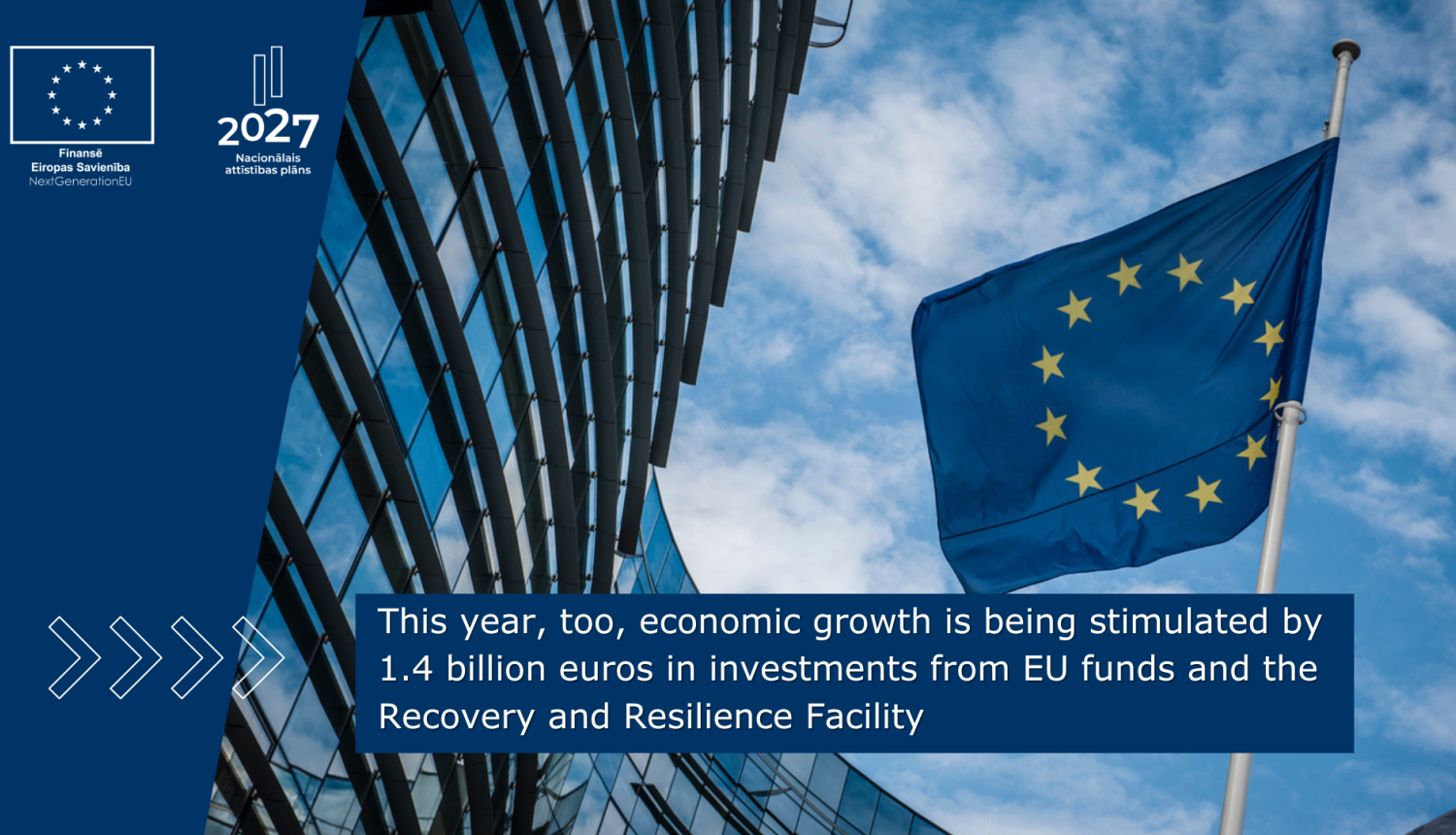
On Tuesday, April 14, the Cabinet of Ministers (CM) reviewed the Ministry of Finance’s (MF) semi-annual report on current developments regarding European Union (EU) Cohesion Policy funds and foreign financial assistance. The data indicates a significant acceleration in investments from the Recovery and Resilience Facility (RRF) and EU Cohesion Policy funds, as evidenced by budget expenditure progress for both 2025 and the first two months of this year, which even surpasses the figures for the corresponding period last year. As the investment surge of 2025 continues, economic growth is projected to have a budget expenditure potential of more than 1.4 billion euros in 2026, when the implementation of the RRF plan concludes.
EU funds investments for the 2021–2027 programming period have entered an intensive implementation phase, and the investment regulatory framework has been developed almost in its entirety. As of March 2026, calls for project selection have been announced for 3.9 billion euros, increasing by 708 million euros over six months and reaching approximately 94% in March. Project contracts have been signed for 2.8 billion euros, with an additional 148 million euros in March, reaching 70%.
It is projected that by mid-2026, project implementation will have reached 86% of the total available EU funding of 4.2 billion euros, and 90% by the end of the year.
Meanwhile, amendments to the EU funds program approved by the government in March have already been submitted to the European Commission (EC) for review, providing for the reallocation of funding to complete the reconstruction of the Latvian Oncology Center, as well as the reallocation of 51.9 million euros to high-readiness priority projects, including 25.5 million euros to strengthen business and industrial capabilities in the defense sector.
With regard to the RRF, the fourth and penultimate payment request for 371.2 million euros was submitted to the EC at the end of 2025; the EC has already approved it, and it is tentatively scheduled to be received as state budget revenue in May of this year. Upon receipt of this payment, Latvia will have received a total of 1.47 billion euros, or 75% of the total allocation of 1.97 billion euros, while the plan’s performance rate reached 76% in March.
The final payment request must be submitted to the EC no later than September 30 of this year. Therefore, in the final year of the RRF plan’s implementation, the responsible authorities are intensifying their oversight of the timely implementation of reforms and investments, particularly those with significant financial impact, including higher education reform and the public transport reform in the Riga metropolitan area. Likewise, large-scale infrastructure projects, including the construction of the southern section of Riga Central Station and the railway electrification project. IT investment projects are also being closely monitored for compliance with procurement and cost requirements, taking into account public reports on proceedings initiated by the EPPO and Corruption Prevention and Combating Bureau in Latvia. The Ministry of Finance is assessing risks and proposals from ministries, as well as consulting with the EC, so that, in the event of significant risks, amendments to the RRF plan can be submitted to the Commission no later than May of this year.
Investments from EU funds and the RRF are already delivering tangible benefits to Latvia’s residents and economy; for example, more than 160 million euros in private investment has been attracted to support research, innovation, and business productivity, more than 1,600 companies have received support, and training and educational opportunities have been provided to more than 7,000 healthcare professionals. At the same time, more than 45,000 residents have been protected from the risk of flooding and other climate disasters, while more than 16,000 people have received employment or job-seeking support. An even more visible return on these investments is expected in the coming years.
Similarly, in EU fund investments, enhanced focus and risk management are critical for the effective implementation of large-scale infrastructure projects and ensuring their functionality, including in railway and hospital infrastructure projects, particularly by completing phased projects initiated during the previous planning period.
Preparations for the next EU fund planning period (2028–2034) are also underway.
Implementation of the new EEA and Norway Grants investment programs could begin in the second half of 2026, following the completion of program preparation and coordination with donors. In accordance with the Memoranda of Understanding with donor countries, the funding allocated to Latvia for the new period amounts to 107 million euros across three priority area programs, including the strengthening of civil protection through the development of a network of shelters and warning sirens. The investments will be implemented by the end of 2032.
Meanwhile, under the Swiss contribution program in Latvia, all contracts for the previously identified projects have been signed, and their implementation will continue until 2029. Program funding of 42.4 million euros is being invested in four areas: the remediation of a historically contaminated site in Aizkraukle, where preparatory work for site cleanup has already been carried out; as well as in an industry-based vocational education program, where an industry-based learning approach is being implemented in collaboration with Swiss experts. In the applied research program, cooperation between Latvian and Swiss partners has already begun on sustainable road construction and energy solutions, while in the pediatric cancer care program, collaboration with Swiss partners is underway to improve diagnostics and develop personalized treatment approaches.