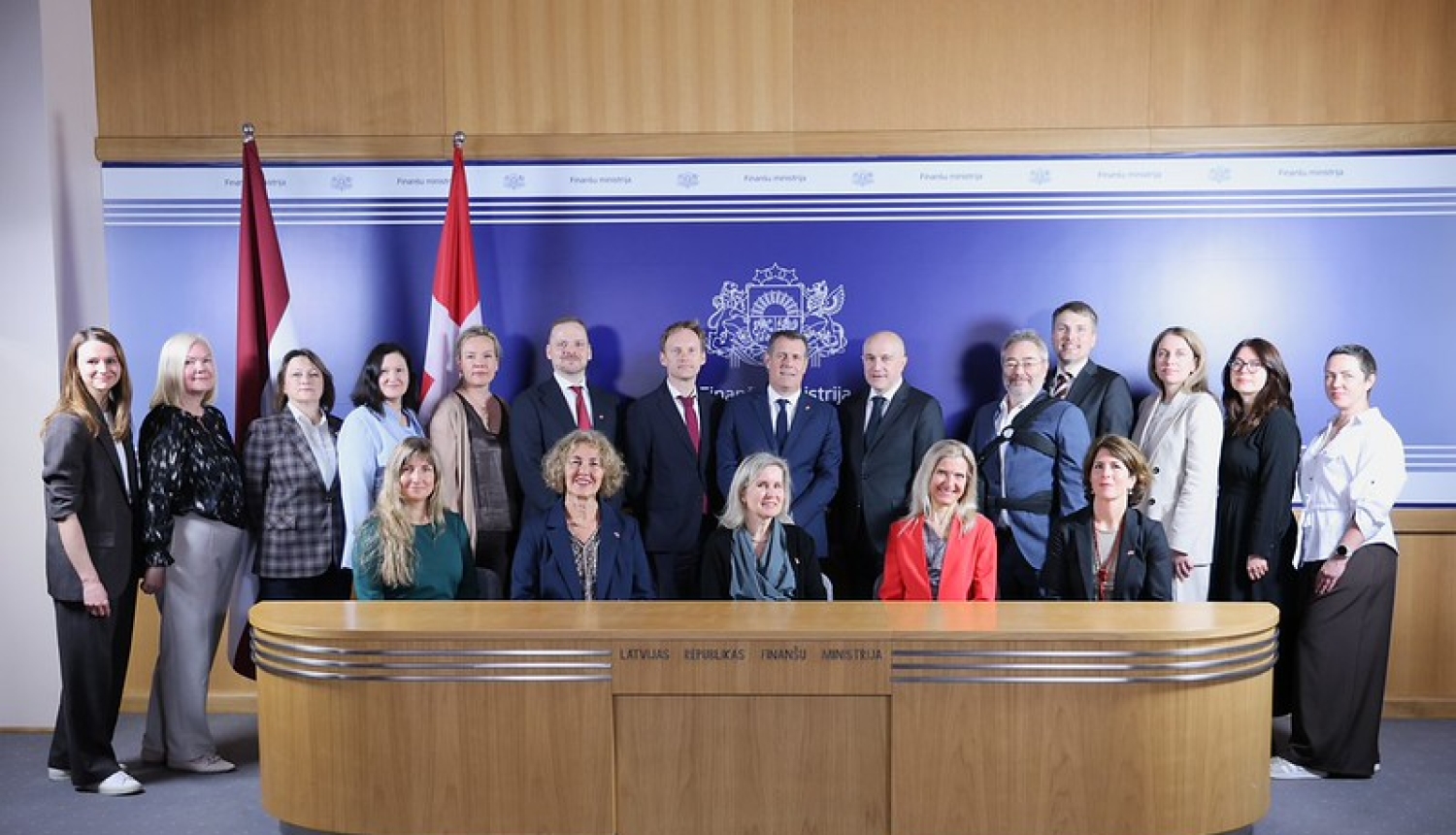
On June 4 and 5, the Ministry of Finance (MoF) hosted the third annual meeting of the Swiss–Latvian Cooperation Programme (Cooperation Programme), during which the MoF briefed Swiss partners on progress in implementing the Cooperation Programme. Since 2025, active implementation has been underway in all four programs, covering investments in pediatric oncology treatment, vocational education, applied research, and the remediation of historical contamination. The discussion focused on achievements to date and the next steps for the successful implementation of the program by the end of 2029.
The transition to active implementation is evidenced by a series of completed tasks, including program launch events, the signing of project and partnership agreements, including with Swiss institutions, the approval of management and control systems at the national and program levels, the approval of the legal framework necessary for the management of the cooperation program and the implementation of each program, as well as the holding of the first meetings of the program management committees.
"The greatest added value of Switzerland's contribution lies not only in funding, but also in partnership and knowledge transfer. During the first year of active implementation, cooperation with Swiss partners has become increasingly practical and results-oriented – from innovation in research and work-based learning approaches in vocational education to expert support in preparing for rehabilitation work and cooperation in the field of pediatric oncology," emphasized Armands Eberhards, Deputy State Secretary at the Ministry of Finance. He thanked the Swiss partners and all the Latvian institutions involved for their professional and close cooperation, which has enabled all four programs to move into the active implementation phase.
"I am delighted to be back in Riga for the annual meeting. It is a significant opportunity to look back on what we have achieved in our cooperation in priority areas and to confirm the progress made. Of particular importance is our ability to share knowledge and experience in areas that are significant for both Latvia and Switzerland – vocational education, healthcare, the remediation of historically contaminated sites, and research. These are strategic priorities for both countries, and we share a common goal – to improve people’s quality of life and ensure tangible benefits for the residents of Latvia. Looking at the bigger picture, we want our cooperation to promote security, stability, and prosperity," noted Pietro Laceri, Head of the Economic Cooperation and Development Division at the Swiss State Secretariat for Economic Affairs (SECO).
The goal of the program “Development of Pediatric Cancer Care in Latvia” is to improve the diagnosis and treatment of oncological diseases in children and adolescents in Latvia, strengthen laboratory capacity, and establish a long-term follow-up system for patients after treatment. Under the program’s project, implemented by the Children’s Clinical University Hospital (CCUH), seven expert teams in pediatric oncology have been established to date; testing of new tools to assess patients’ health status and quality of life during and after treatment has begun; educational materials have been prepared for patients and their families, and specialists’ competencies have been strengthened through international training.
CCUH is implementing the project in collaboration with Swiss partners – the University Hospital of Zurich and the University Hospital of Lausanne – with whom the signing of a partnership agreement has already begun.
The program’s total funding is 9.3 million euros, including 7.9 million euros from Switzerland and 1.4 million euros from the Latvian state budget.
As part of the “Remediation of Historically Contaminated Sites” program, the site of the former reinforced concrete factory in Aizkraukle is scheduled to be remediated by the end of 2029, thereby reducing the leaching of contaminants into the soil, groundwater, and the Daugava River, as well as mitigating health risks to residents. To date, in collaboration with Swiss experts, procurement documentation for the remediation work has been developed and site preparation work has been carried out. The current goal is to begin remediation work as soon as possible to achieve significant environmental improvements and reduce the impact of historical contamination on the surrounding environment. The project specified in the program is being implemented by the State Environmental Service in cooperation with the Aizkraukle Municipality.
The program’s total funding is 15.2 million euros, including 12.9 million euros from the Swiss contribution and 2.3 million euros from the Latvian state budget.
The “Partnership in Applied Research” program strengthens cooperation between Latvia and Switzerland in the fields of innovative materials, information and communication technologies, and smart energy. The program has identified two projects in which researchers and doctoral students have been recruited to date, and the first research projects have been developed, in which the Institute of Solid State Physics at Riga Technical University (RTU) and the University of Latvia (LU) Institute of Solid State Physics, together with Swiss partners, are developing sustainable road construction solutions, next-generation batteries, hydrogen technologies, and artificial intelligence solutions for power grid stability. Similarly, the Swiss–Latvian Digital Center was opened in Riga in May, strengthening innovation in the energy sector.
Both projects are being implemented in close cooperation with Swiss partners – the Swiss Federal Institute of Materials Science and Technology, the Paul Scherrer Institute, the Zurich University of Applied Sciences, and the Swiss Center for Electronics and Microtechnology. The program’s total funding is 12.3 million euros, including 10.5 million euros from Switzerland and 1.8 million euros from the Latvian state budget.
The program “Strengthening Work-Based Learning to Improve Vocational Education and Training in Latvia” strengthens the link between vocational education and the needs of the labor market and promotes employer involvement in the learning process. To date, in collaboration with Swiss experts, the implementation of a sector-based training approach has been initiated, new training and assessment models have been developed in the mechanical engineering, agriculture, hospitality, and energy sectors, and pilot programs will soon be launched at vocational education institutions. An open call for proposals is planned in the near future for higher education institutions to develop teacher training programs for vocational education. This will strengthen the role of industries in vocational education and promote the training of qualified specialists for the Latvian labor market.
The project specified in the program is being implemented by the State Education Development Agency in cooperation with the Swiss Institute for Vocational Education and Training, the Swiss Federal Department of Education, Research, and Innovation, and Hotel & Gastro Formation. The program’s total funding is 12.35 million euros, including 10.5 million euros from Switzerland’s contribution and 1.85 million euros from Latvia’s state budget.
In addition to the annual meeting, the Swiss delegation, along with other participants, also visited two program projects. On June 4, at Riga Technical University, researchers, faculty, and students introduced the Swiss representatives to solutions developed within the applied research program in the fields of construction, and road construction materials, also demonstrating 3D concrete printing and optical fiber technology laboratories.
On June 5, the delegation visited Riga State Technical School, where the school’s administration, teachers, and students demonstrated how work-based learning is implemented in vocational education. The guests familiarized themselves with the learning process and practical classes in the fields of energy, rail transport, automotive technology, printing, and media technology, and also discussed cooperation with employers and industry organizations.
